

If you asked me, I would tell you that the worst part of any application process is the writing, and applying for scholarships is no different. It’s not the length of writing that I find extremely difficult, although this may be true for you. It’s the fact that someone is judging you purely based on your writing. Like what? How is that fair?
Won the olympics?
Nope, you aren’t getting the scholarship if your writing sounds like my seven-year-old brother wrote it. (Though I’ve never read his writing, and he’s pretty smart, so maybe he could write a college-level essay.)
Cured cancer?
Nope, you still aren’t getting the scholarship, unless your writing is interesting. Well… maybe in this case you would, but if you cured cancer, what is the point of college? You’re a genius, and I wish I were that smart.
So how do you get started writing the essay? How do you create a masterpiece in 250 words or less? How do you get the scholarship provider to choose you out of however many candidates from less than a page of words, and after they are already exhausted from reading tons of essays before yours?
It’s simple, really. You tell a story.
Writing is all about engaging the reader. If there is no movement through your writing, it falls flat, and the reader is not engaged. So while they may end up reading your essay, they won’t remember it. It won’t stand out, and you will be unlikely to get it.
You may be asking, “Well Brittany, how do I write a story from a prompt that asks me something basic like why I deserve this scholarship and when I am limited to less than 300 words?”
Yea, so earlier when I said it is simple, I lied. Being able to tell a story in your writing, especially about something so informative and with limited characters, is extremely difficult, and it requires practice. Remember when I said that applying for many scholarships improves your writing? Yea, me too. (If you don’t, you didn’t read my last post and smh, but I forgive you.)
have a strong introduction
Do not, I repeat DO NOT, start your essay or short answer response by restating the question. While this is how you typically answer prompts in your English class or in an interview, this is not how you answer a scholarship question, at least not in a memorable way. Reason being, most people are probably going to start their essay like that, too.
With such limited words, you have to be strategic about every word that you write. When you open your response, you need to open it with something more interesting than, “I feel that I am deserving of this scholarship because…” Not only is it an utterly boring and not well-thought out response, the reasons you list are likely to be similar to every other applicant.
Don’t believe me? Let me guess. You need the money. You don’t want to have to work in college. You’ll be able to spend more time studying if you don’t have to work. College is expensive, and you want to reduce your potential student loan debt. You are a hard-working student involved in many activities.
I am not a scholarship provider, but even I have heard it all before.
They know that everyone has the same core reason for wanting the scholarship. It is all about how you present that need.
Start your essay with a two-liner memory, an epiphany that you had, or an *appropriate* quote from your favorite rapper, so long as you explain how it relates to you and how you want to grow or have grown. After all, attending college is all about further developing yourself. Consequently, you want that desire to show through in your writing. You want to attract the reader from the start and indirectly show them something meaningful to you. So, spend anywhere from one to a few sentences developing your story, depending on how many words you are limited to.
Now, I am not saying to go on a tangent, but you want to open with a “hook.” If you can tell a notable story or perspective of your life, effectively tricking the reader into thinking your essay response is not an essay response, and then segment that into how it relates to why you deserve the scholarship, then congratulations, because you, my friend, have just crafted a climactic response.
For example, in one of my essays (which I have manipulated for many applications I have written, even to this day), I start by describing an experience I had in New York City. I use non-basic and descriptive words to depict the amazement that I felt at the chaos that is that city. I then proceed to relate that memory to my desire to learn about the world around me. In turn, I relate that passion and desire to cultivate myself to why I have participated in and made an effort to balance multiple activities in high school (aka, indirectly showing that I am a hard worker and well-versed, without directly saying those common descriptors), which in turn hints to why I feel I am deserving of said scholarship.
Note, however, that I am not saying to write about some event and then, in the last sentence, just state that you deserve the scholarship because the memory you just explained shows that you are a hard worker. No, everything needs to build on each other and correlate. You still want to be academic about the piece.
Write with a purpose.
If you were bored writing the essay and did not write with any direction, the reader is going to be able to tell because your mood will come through in your writing.
use strong and engaging words
Once again, you have a limited amount of words to get your point across. As such, all words matter, and you need to write in such a way that the reader understands that you understand that fact.
As you are aiming to describe an aspect of yourself to the reader with this response, you need to make sure you are able to paint a picture about yourself. This means you need to use adjectives throughout your response, or at the least, somewhere.
Do not waste your words on basic adjectives like that you would be a good candidate.
Do liven your words on powerful adjectives like that you would be a proactive and bold candidate.
This does not mean to throw big, “SAT vocab words” into your response just to show you are an #Intellect. You need to understand how whatever word you are using adds to your response, and that it is cohesive with the style and academic level that you wrote the rest of your essay.
tying it all together
The end of your essay is where you take one or two sentences, or a paragraph depending on what the length limit was, to restate your answer to the prompt. This part of the essay is very similar to writing in your English class. You want to provide a conclusion for the reader and summarize the key ideas of your response.
Everything that I said not to do in the introduction, you basically want to do here. You want to tell them that you deserve the scholarship because you are a hardworking learner who has a passion to invest in your future, or whatever else your reason is. You already explained the why in your essay, so restate it here. This way, the reader is not left questioning the point of your essay.
For short essay responses, such as those around 250 words, it is important that you stick to one main idea that answers the prompt. However, whatever this idea is that you want to focus on, you want to exude a strong desire to develop yourself. Tell a short story about your growth. Talk about something you are passionate about. Describe your curiosity. Be humble, but highlight your unique characteristics and drive.
For essay responses where you are allowed over 500 words or so, you either need to have one really good main reason, or diversify and talk about two, or maybe, three reasons why you are deserving of the scholarship.
Finally, if you are able to turn in your response as a file (such as a .doc), instead of having to type it into a text box provided on their application website, then title your response. Titling your short essay will allow for you to provide the reader an encompassing summary of what your piece is about or the main idea you are trying to push through, as well as show your thoughtfulness, further separating you from your peers. This works best for longer essays and when you only have to submit one essay for the application. If you have to answer multiple questions, it is best to just use the essay questions as the “titles” for your response.
For instance, in an essay where the essay was “What position in life do you hope to have in five years and what do you need to do to accomplish this goal?” and I had a limit of two typed, double-spaced pages, I titled my work “Pursuing Passions.” I focused my essay on how I wanted to expand upon my knowledge, and wanted to emphasize that this curiosity is something I am passionate about and want to take action in.
In another essay that asked me to address my financial need, the major I was pursuing, and how I planned to use my education after graduation, I titled my response “The Push to Higher Education.” In this essay, I wrote about obstacles I faced up to said point and how I desired to pursue my education further in college. I used the title to emphasize the fact that, regardless of what I have faced, I desire to better myself and expand on my knowledge.
some of my essay responses
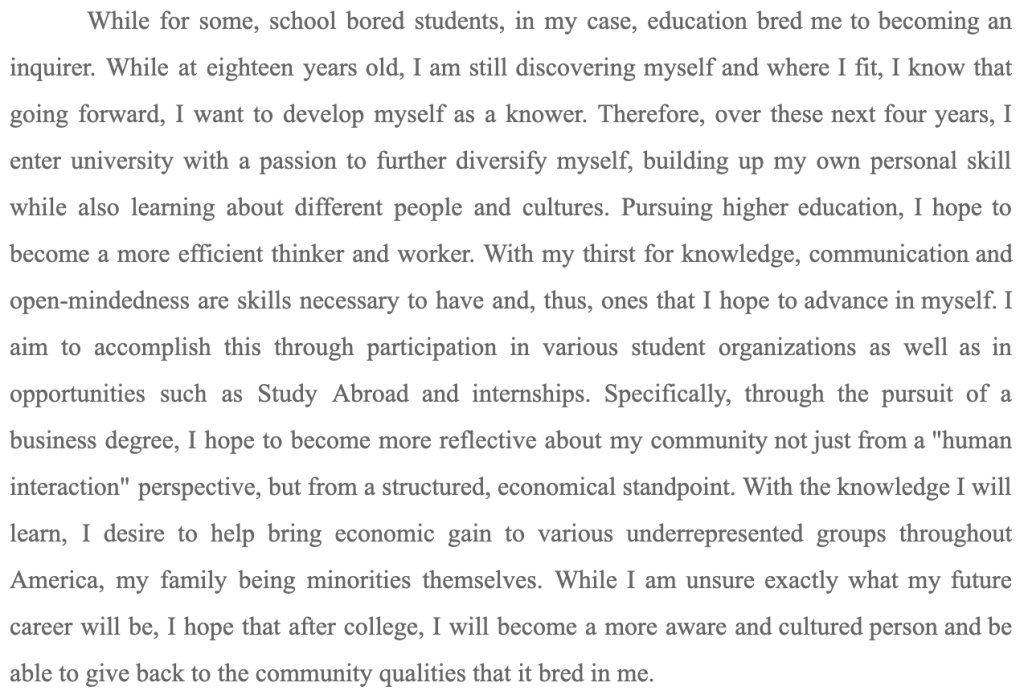
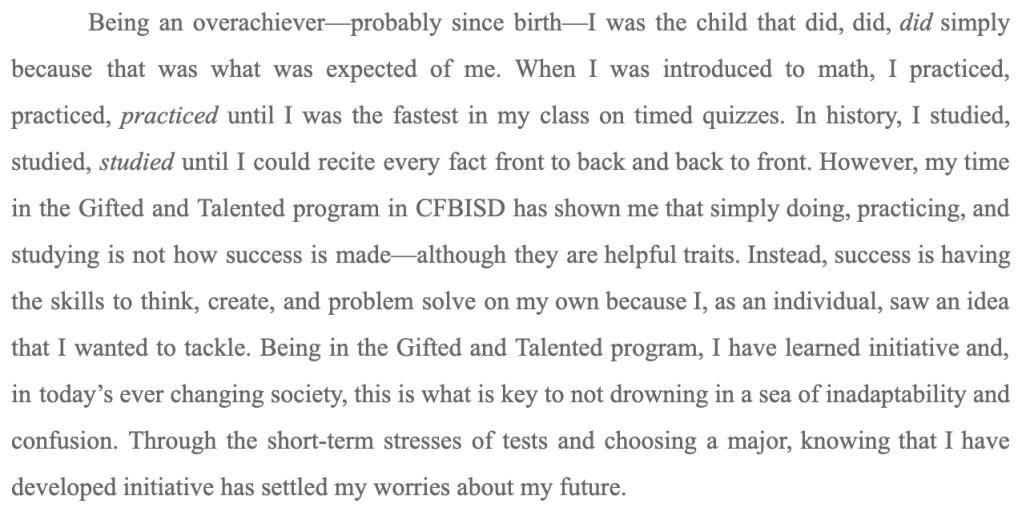
Here are a couples excerpts from some of my shorter essay responses. I didn’t include any of my long essay responses so that you could use your creativity to craft a response more personal to you.
What are your educational goals?
How has your participation in G/T impacted you?
Reading this post, but don’t know where to start in applying for scholarships? Read my last post about how to Overcome the Scholarship Process.

 brittany given.